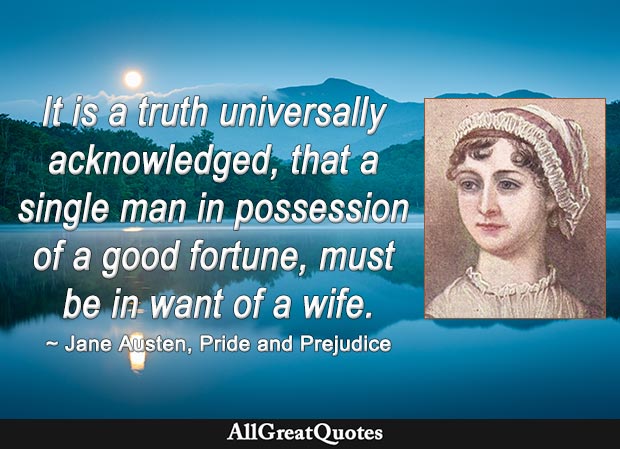
It is a truth universally acknowledged, that a single man
in possession of a good fortune, must be in want of a wife.
Pride and Prejudice
Opening sentence of novel, Chapter 1. |
She was a woman of mean understanding, little information,
and uncertain temper.
Pride and Prejudice
About Mrs. Bennett, Chapter 1. |
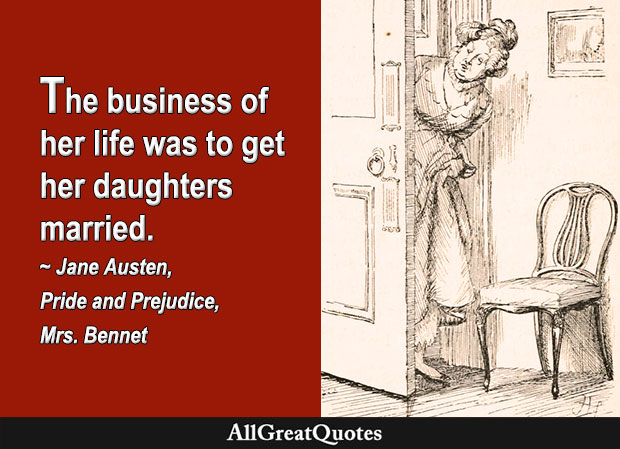
The business of her life was to get her daughters married.
Pride and Prejudice
About Mrs. Bennett, Chapter 1. |
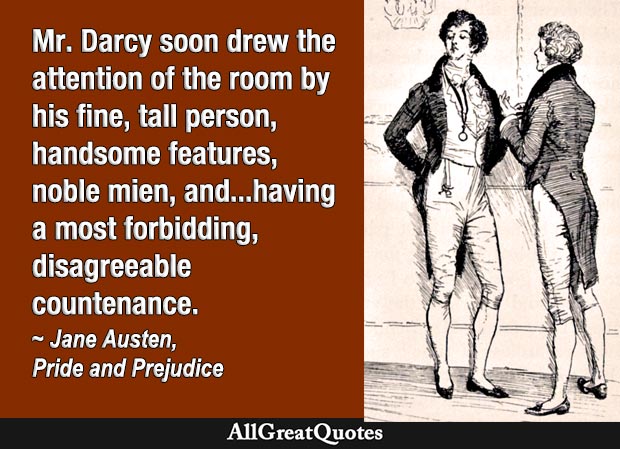
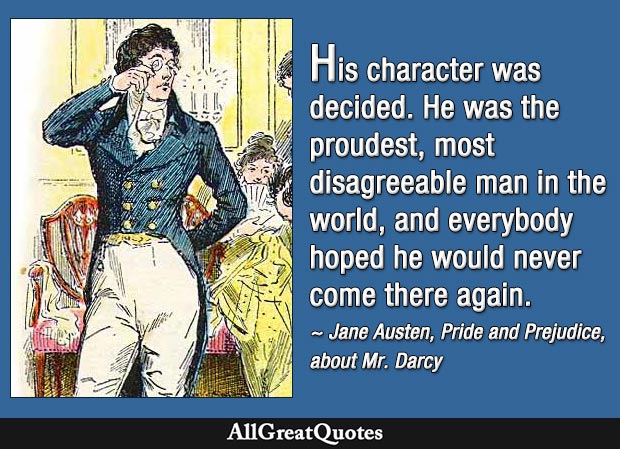
The gentlemen pronounced him to be a fine figure of a man,
the ladies declared he was much handsomer than Mr. Bingley,
and he was looked at with great admiration for about half the
evening, till his manners gave a disgust which tuned the tide
of his popularity; for he was discovered to be proud, to be
above his company, and above being pleased; and not all his
large estate in Derbyshire could then save him from having a
most forbidding, disagreeable countenance, and being unworthy
to be compared with his friend.
Pride and Prejudice
Other characters' reaction to Mr. Darcy,
Chapter 3. |
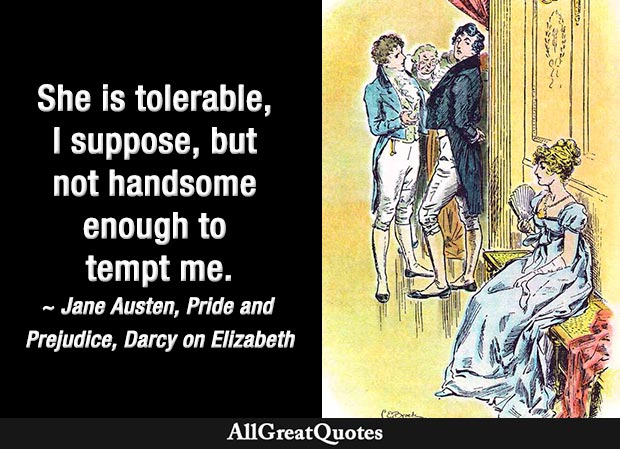
She is tolerable, I suppose, but not handsome enough to tempt
me; I am in no humour at present to give consequence to young
ladies who are slighted by other men. You had better return
to your partner and enjoy her smiles, for you are wasting your
time with me.
Pride and Prejudice
Mr. Darcy to Mr. Bingley about Elizabeth
Bennet, Chapter 3. |
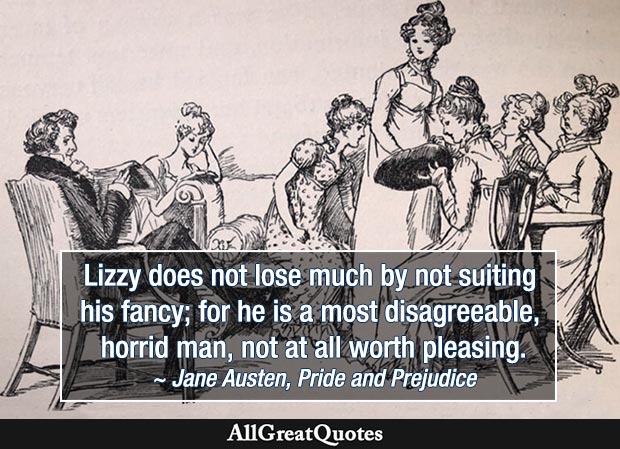
"But I can assure you," she added, "that Lizzy
does not lose much by not suiting his fancy; for he is a most
disagreeable, horrid man, not at all worth pleasing. So high
and so conceited that there was no enduring him! He walked here,
and he walked there, fancying himself so very great! Not handsome
enough to dance with! I wish you had been there, my dear, to
have given him one of your set-downs. I quite detest the man."
Pride and Prejudice
Mrs. Bennet to Mr. Bennet about Mr. Darcy,
Chapter 3. |
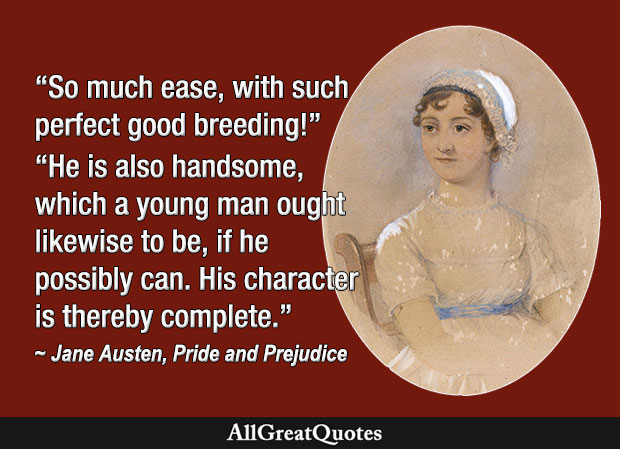
"Oh! you are a great deal too apt, you know, to like
people in general. You never see a fault in anybody. All the
world are good and agreeable in your eyes. I never heard you
speak ill of a human being in your life."
"I would not wish to be hasty in censuring anyone; but
I always speak what I think."
"I know you do; and it is that which makes the wonder.
With your good sense, to be so honestly blind to the follies
and nonsense of others! Affectation of candour is common enough
one meets with it everywhere. But to be candid without
ostentation or design to take the good of everybody's
character and make it still better, and say nothing of the bad
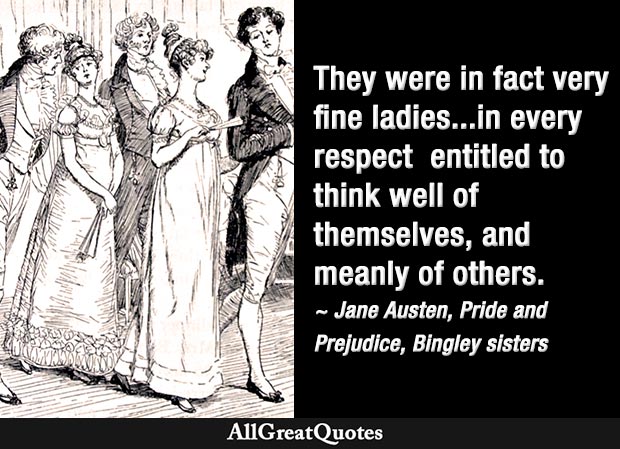
belongs to you alone. And so you like this man's sisters,
too, do you? Their manners are not equal to his."
Pride and Prejudice
Elizabeth Bennett to her sister Jane, Chapter
4. |
I could easily forgive his pride, if he had not mortified
mine.
Pride and Prejudice
Elizabeth about Darcy, Chapter 5. |
Vanity and pride are different things, though the words are
often used synonymously. A person may be proud without being
vain. Pride relates more to our opinion of ourselves, vanity
to what we would have others think of us.
Pride and Prejudice
Mary Bennett, Chapter 5. |
If a woman is partial to a man, and does not endeavour to
conceal it, he must find it out.
Pride and Prejudice
Elizabeth, Chapter 6. |
Happiness in marriage is entirely a matter of chance. If the
dispositions of the parties are ever so well known to each other
or ever so similar beforehand, it does not advance their felicity
in the least. They always continue to grow sufficiently unlike
afterwards to have their share of vexation; and it is better
to know as little as possible of the defects of the person with
whom you are to pass your life.
Pride and Prejudice
Charlotte Lucas, Chapter 6. |
Occupied in observing Mr. Bingley's attentions to her sister,
Elizabeth was far from suspecting that she was herself becoming
an object of some interest in the eyes of his friend. Mr. Darcy
had at first scarcely allowed her to be pretty; he had looked
at her without admiration at the ball; and when they next met,
he looked at her only to criticise. But no sooner had he made
it clear to himself and his friends that she hardly had a good
feature in her face, than he began to find it was rendered uncommonly
intelligent by the beautiful expression of her dark eyes. To
this discovery succeeded some others equally mortifying. Though
he had detected with a critical eye more than one failure of
perfect symmetry in her form, he was forced to acknowledge her
figure to be light and pleasing; and in spite of his asserting
that her manners were not those of the fashionable world, he
was caught by their easy playfulness. Of this she was perfectly
unaware; to her he was only the man who made himself agreeable
nowhere, and who had not thought her handsome enough to dance
with.
Pride and Prejudice
Chapter 6. |
I have been meditating on the very great pleasure which a
pair of fine eyes in the face of a pretty woman can bestow.
Pride and Prejudice
Darcy to Miss Bingley, Chapter 6. |
A lady's imagination is very rapid; it jumps from admiration
to love, from love to matrimony, in a moment.
Pride and Prejudice
Elizabeth, Chapter 6. |
No one can be really esteemed accomplished who does not greatly
surpass what is usually met with.
Pride and Prejudice
Caroline Bingley, Chapter 8. |
"Nothing is more deceitful," said Darcy, "than
the appearance of humility. It is often only carelessness of
opinion, and sometimes an indirect boast."
Pride and Prejudice
Chapter 10. |
The power of doing anything with quickness is always prized
much by the possessor, and often without any attention to the
imperfection of the performance.
Pride and Prejudice
Darcy, Chapter 10. |
You expect me to account for opinions which you choose to
call mine, but which I have never acknowledged.
Pride and Prejudice
Darcy to Elizabeth, Chapter 10. |
"To yield readily - easily - to the persuasion of a friend
is no merit."
"To yield without conviction is no compliment to the understanding
of either."
"You appear to me, Mr. Darcy, to allow nothing for the
influence of friendship and affection."
Pride and Prejudice
Elizabeth and Darcy, Chapter 10. |
She hardly knew how to suppose that she could be an object
of admiration to so great a man.
Pride and Prejudice
Elizabeth about Darcy fixing his eyes on
her, Chapter 10. |
Elizabeth, having rather expected to affront him, was amazed
at his gallantry; but there was a mixture of sweetness and archness
in her manner which made it difficult for her to affront anybody;
and Darcy had never been so bewitched by any woman as he was
by her. He really believed, that were it not for the inferiority
of her connections, he should be in some danger.
Pride and Prejudice
Chapter 10. |
I declare after all there is no enjoyment like reading! How
much sooner one tires of anything than of a book! When I have
a house of my own, I shall be miserable if I have not an excellent
library.
Pride and Prejudice
Miss Bingley, Chapter 11. |
My good opinion once lost, is lost forever.
Pride and Prejudice
Darcy, Chapter 11. |
There is, I believe, in every disposition a tendency to some
particular evil a natural defect, which not even the
best education can overcome.
Pride and Prejudice
Darcy, Chapter 11. |
It is happy for you that you possess the talent of flattering
with delicacy. May I ask whether these pleasing attentions proceed
from the impulse of the moment, or are the result of previous
study?
Pride and Prejudice
Mr. Bennett, Chapter 14. |
Mr. Collins was not a sensible man, and the deficiency of
nature had been but little assisted by education or society.
Pride and Prejudice
Chapter 15. |
Mr. Collins had only to change from Jane to Elizabeth
and it was soon done done while Mrs. Bennet was stirring
the fire.
Pride and Prejudice
Chapter 15. |
In his library he had always been always sure of leisure and
tranquillity; and though prepared ... to meet with folly and
conceit in every other room in the house, he was used to be
free of them there.
Pride and Prejudice
About Mr. Bennett, Chapter 15. |